

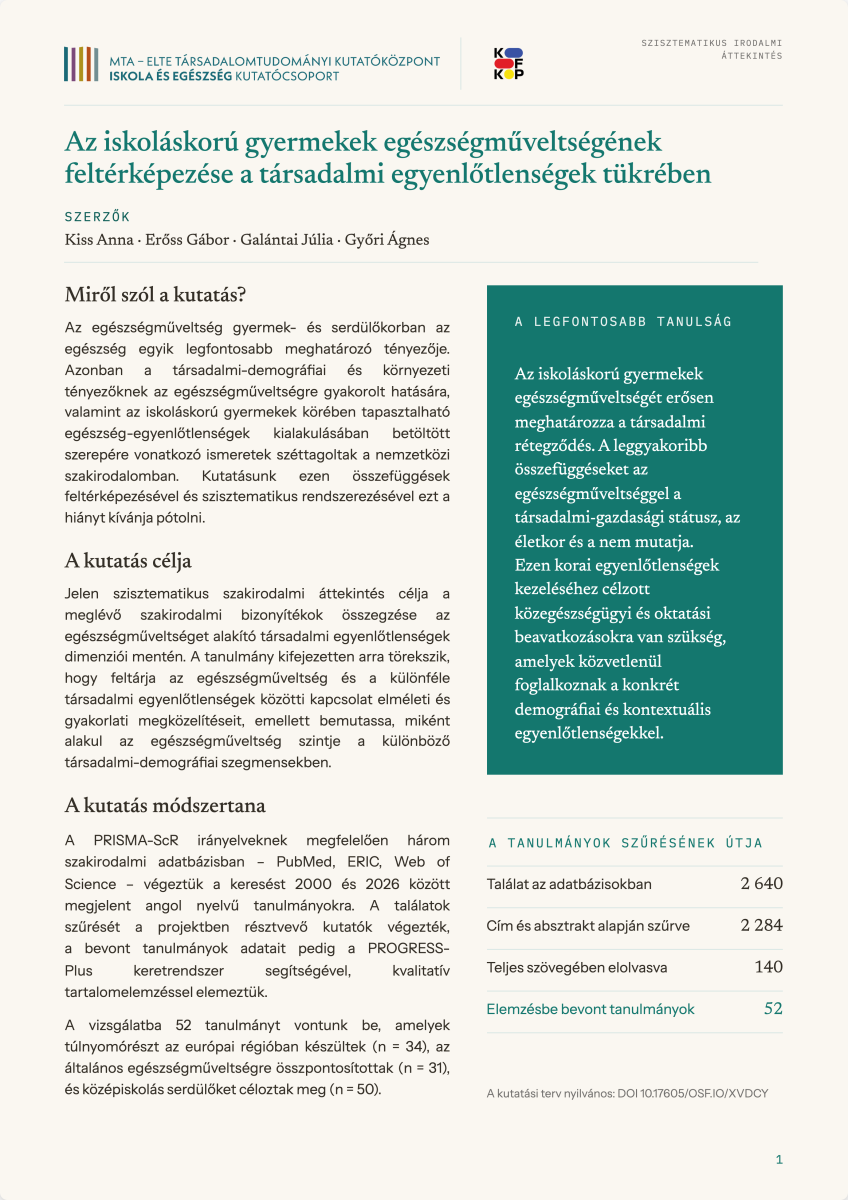
Health literacy is one of the key determinants of health during childhood and adolescence, yet evidence on how sociodemographic and environmental factors shape it, and how they contribute to health inequalities in younger populations, remains fragmented in the literature. Our research group’s scoping review maps this evidence for school-aged children in developed countries. Following the PRISMA-ScR guidelines, three databases – PubMed, ERIC and Web of Science – were searched for English-language studies published between 2000 and 2026; after screening the 2 640 records identified, 52 studies were included and qualitatively synthesized using the PROGRESS-Plus equity framework.
Our synthesis reveals that health literacy is strongly patterned by social stratification, showing the most consistent associations with socioeconomic status, age and gender. Gender differences follow domain-specific patterns: girls scored higher in general and mental health literacy, boys in the digital and physical domains. Higher health literacy was linked to more favourable health behaviours and better subjective health. Addressing these early inequalities requires targeted public health and educational interventions that directly tackle specific demographic and contextual disparities. Building on these findings, the review offers practical guidance for teachers and recommendations for educational institutions.
Downloadable version: Mapping health literacy and social disparities in school-aged children through the PROGRESS-Plus framework (PDF, in Hungarian)