

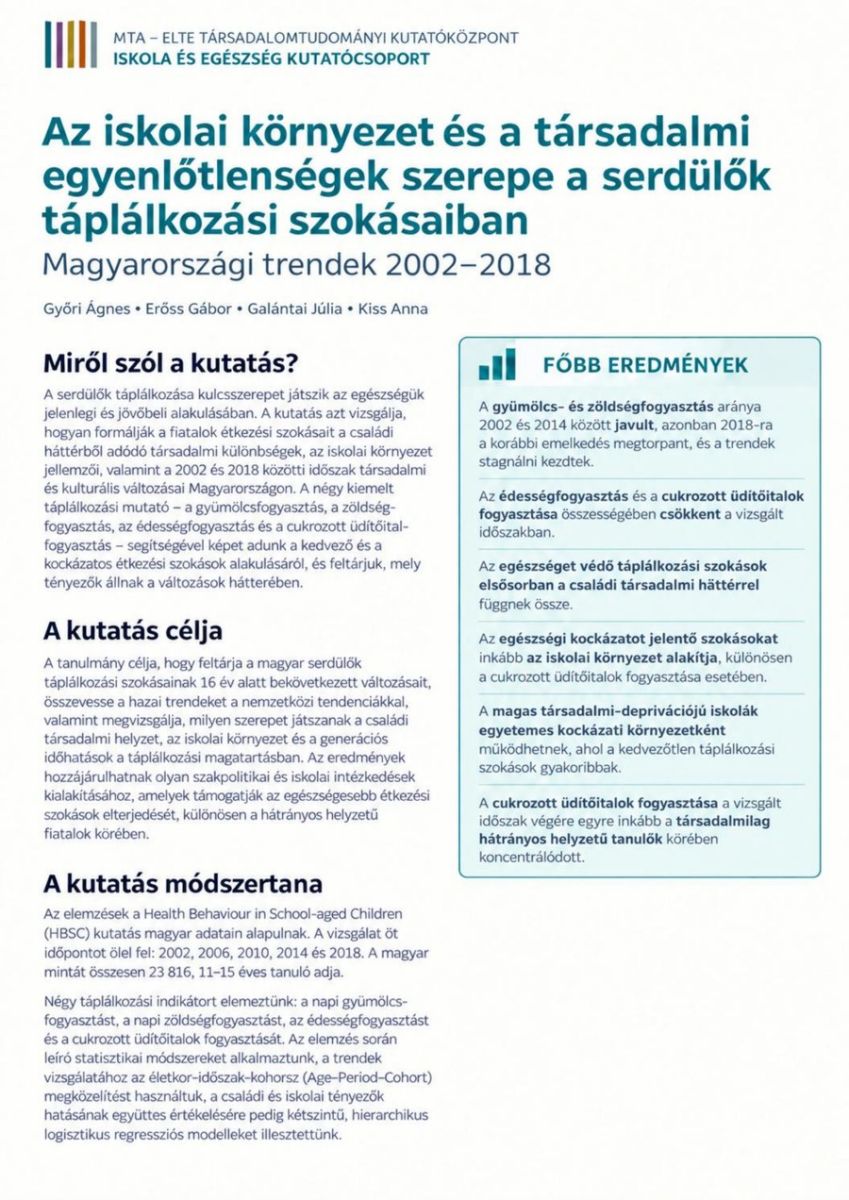
Adolescents’ diet plays a key role in their present and future health. Drawing on the Hungarian data of the Health Behaviour in School-aged Children (HBSC) survey from five waves between 2002 and 2018 (23 816 students aged 11–15), our research group examined how family social background, the school environment and broader social changes shape young people’s eating habits. The analysis follows four indicators – daily fruit, vegetable, sweets and sugar-sweetened soft drink consumption –, compares Hungarian trends with the other Visegrád countries and the European average, and uses age–period–cohort analysis and two-level hierarchical logistic regression models to assess the joint effect of family and school factors.
Fruit and vegetable consumption improved until 2014 but stagnated by 2018, while the consumption of sweets and sugary soft drinks declined over the period as a whole, although Hungarian adolescents still drink sugary soft drinks considerably more often than their European peers. Health-protective habits are linked primarily to family social background, whereas health-risk habits are shaped more by the school environment: schools with high social deprivation can act as universal risk environments, and by 2018 daily soft drink consumption had become increasingly concentrated among socially disadvantaged students. The overview closes with practical recommendations for education and health policy actors.
Downloadable version: The role of the school environment and social inequalities in adolescents’ eating habits (PDF, in Hungarian)